

Interview with Jake Fern: Between Realism and the Hidden
An interview for art print outlet Animato.

Introduction
Brighton-based artist Jake Fern blends realism, poetry, and political undertones in his work, exploring the tension between what is seen and what lies beneath. His acclaimed Righteous Brothers series reimagines fictional book covers from a future looking back at our chaotic present — fusing narrative, satire, and painterly craft. We spoke with Jake about his creative journey, influences, and artistic process.
1. Where did your journey into art begin?
Like most children, I loved drawing. My mum was also an artist and always encouraged me, so it felt natural to follow that path. I always knew I wanted to go to art college and assumed it would become my career.
2. How has your creative style evolved over the years?
I’ve always been torn between realism and abstraction — clarity and fuzziness, the apparent and the hidden. Over time, I’ve become more comfortable living in that tension.
There comes a point in any artistic career where things start to make sense — when you hit a flow or a certain method of working, and everything becomes easier. In essence, that’s finding your voice and becoming comfortable with it.
3. What have been some key milestones or turning points in your career?
I’ve always painted, drawn, written songs, and written stories. But it wasn’t until lockdown that I fully committed to painting as my main focus — and from then, everything changed.
Being accepted into the Royal Society of Portrait Artists Exhibition was a huge achievement. Exhibiting among such talent — in a bastion of old-school representational art — was incredibly rewarding. Winning Sussex Portrait Artist of the Year (2025) was another highlight.
4. Where do you live and work now, and how does that environment influence your art?
I live in Brighton, between the sea and the hills. I’m sure at some point my focus will shift from portraiture to landscape — there’s such a wealth of beauty here.
5. Were there any specific artist movements or experiences that first inspired you?
As a kid, I loved drawing Asterix and Tintin, so Hergé and Uderzo were early influences. Growing up in Birmingham, I was surrounded by Pre-Raphaelite art — a powerful influence on a young, romantic teenager.
I’ve always loved representational and romantic art — especially Edvard Munch and Caspar David Friedrich. Later, I became drawn to more political statements, admiring the Situationists and their radical anarchism.
6. How would you describe your artistic style to someone discovering your work for the first time?
Poetic, yet realistic. Loose, but representational. Political, but never didactic.
7. Can you walk us through your typical process from idea to finished piece?
With The Righteous Brothers, everything starts with an intellectual idea — often a book title. From there, I do a visual search online, gather references, then make hand-drawn mock-ups, followed by Photoshop mock-ups. Finally, I take the concept to the canvas.
8. What materials or tools are essential to your practice?
Big canvases! The Righteous Brothers works are typically around six feet high. So, lots of canvas, lots of wood, and lots of paint.
9. Are there any rituals or habits that help you get into the creative flow?
Getting up in the morning.
10. How do you know when a piece is finished?
I don’t!
11. Are there recurring themes or moods in your work?
Someone once walked around an exhibition of mine and said, “All the women you paint look like they’ve lost something.”
I think that’s true — throughout both my portraiture and Righteous Brothers pieces, there’s a sense of longing. A longing for home, or for something just out of reach.
12. What role do nature, memory, or identity play in your art?
Nature is everything. Beauty and truth are everything.
I remember a dream from when I was three or four — I was on a strange planet being drawn up into the sky, saying goodbye to my soulmate. I woke up crying and never forgot it.
Identity itself can be a trap. Identity politics, in my opinion, is a bottomless pit that keeps the ego intact — falling forever without ever shattering and setting you free.
13. Do your works tell a story, or do you prefer abstract expression?
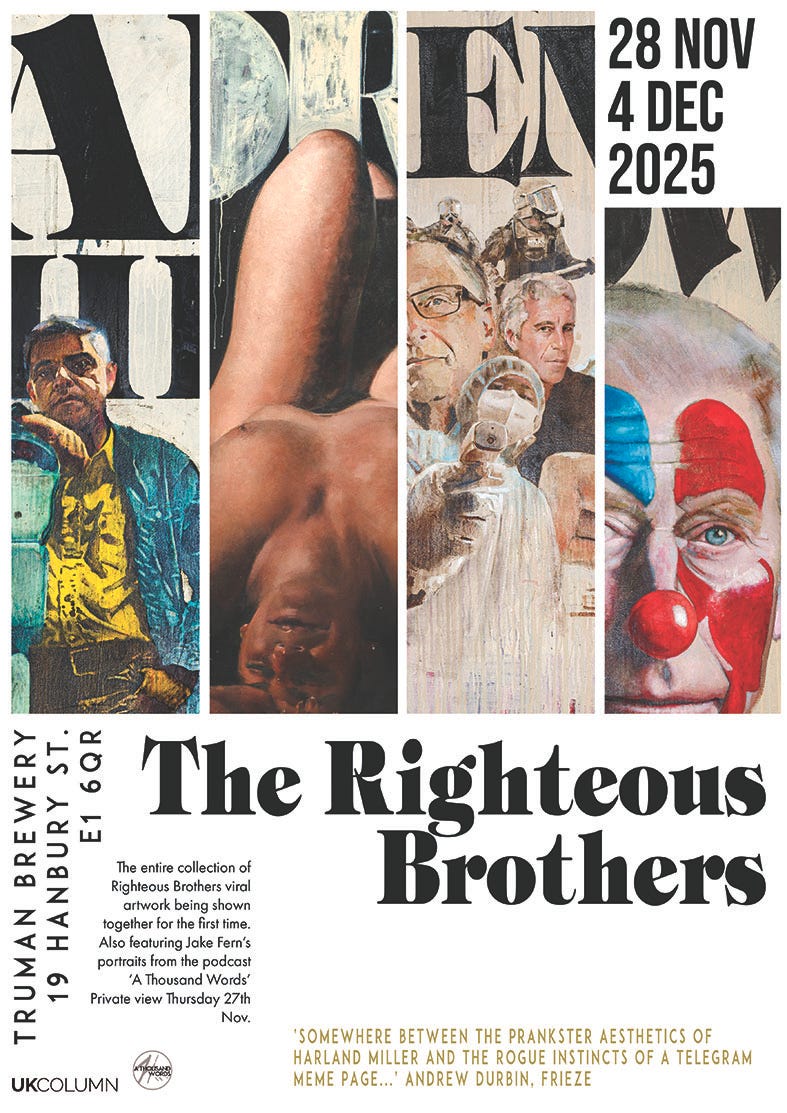
All of The Righteous Brothers paintings are storytelling at their core. They’re book covers for novels that don’t exist — imagined from a futuristic perspective, looking back at the madness of our time.
14. How do colour and composition come into play for you?
Colour isn’t something I consciously think about. You choose paints on some intuitive level — your palette reflects your emotional state.
15. Has your work been shaped by travel or specific life experiences?
Every moment you’ve lived informs every mark you make — perhaps even from before you were born.
But living for five years in a mud hut on the edge of a refugee camp in Sudan profoundly shaped my perspective. My view of Western culture is always defined, at least partly, by that experience.
16. Do you imagine your work in someone’s home as you’re creating it?
Yes, always — especially The Righteous Brothers pieces. People often buy them as conversation starters.
17. What kind of spaces do you feel your work fits best in?
Big ones.
18. Have you seen your art styled in interiors that surprised or delighted you?
It surprises and delights me to see it anywhere.
19. Are there particular print formats that you favour?
The Righteous Brothers works translate well both at their original six-foot scale and as smaller A4 prints — fitting, given their book cover origins.
20. If you curated a wall of your own work at home, which pieces would you choose?
They tend to rotate. Right now, we’ve got Follow the Science above the dining table — though having Bill Gates staring at us while we eat can be slightly off-putting.
21. What’s next for you?
We have a big show in London from 27th November to 4th December at the Truman Brewery, Spitalfields.
22. Where can people follow your work or see behind the scenes?
On my Substack — just search for “Jake Fern”.
23. One artwork you wish you’d made?
Pretty much anything by Nick Alm.
24. Dream artist to collaborate with?
The other Righteous Brothers.
25. A colour you’re currently obsessed with?
Transparent red oxide.
26. What’s on your studio playlist lately?
Future Islands.
Love your righteous art Jake. Many thanks bro. Kman, editor, Digileak News Not Noise, Bitchute